

Why Do Call Center Headsets Need Hearing Protection?
Leave a message
Many users report tinnitus or hearing loss after long-term use of noise-cancelling gear. The real culprits? Excessive duration, uncontrolled volume, and over-reliance on noise cancellation.
Do you instinctively max out the volume during calls? Your ears might be quietly sounding an alarm.
As a leading manufacturer of professional communication headsets, we've noticed a pattern: in busy call centers, the heavier the call volume, the louder the headset goes. When the environment gets noisy or call quality drops, people naturally turn up the volume.
However, this habit is a hidden danger. Today, let's discuss why your current "noise cancelling" gear might be missing the mark, and why a truly professional office headset noise cancelling solution must do more than just block sound-it must protect your hearing.
Click the image below for details
1. Why Noise Cancellation Alone Can't Save Your Ears
Many assume, "If the headset blocks out background noise, I can listen at a lower, safer volume." Ideally, yes. In reality, not quite.
Standard noise cancellation mainly filters out mid-to-low frequency droning (like air conditioners or fans). However, human voices and the chatter in a busy office are often mid-to-high frequency "piercing sounds," where noise cancellation is far less effective.
The critical issue is that many consumer-grade headsets solve the "can I hear it?" problem but ignore the "is it too loud?" problem. When call quality is unstable, you subconsciously slide that volume bar up. Hours of continuous "high-volume output" amounts to chronic acoustic trauma.
2. Not All Headsets Come with SoundGuard
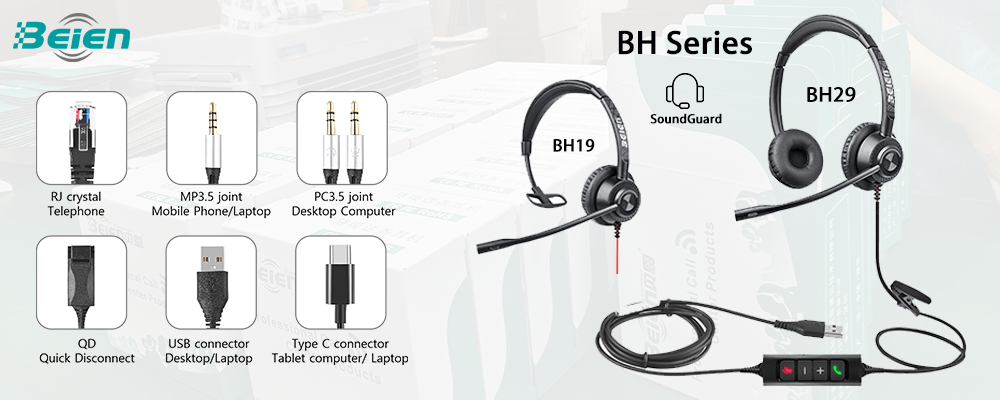
You might not be familiar with SoundGuard technology. It is a specialized feature in high-end business and call center gear designed to prevent irreversible hearing damage. Unlike standard digital processing, it often uses analog circuits to provide robust protection-but crucially, not every headset has it.
SoundGuard's core function is to eliminate sudden high-noise spikes exceeding 118dB. For example, the "pop" from plugging in a device or a sharp feedback screech if a headset drops. A standard headset lets these pulses hit your ears directly; SoundGuard flattens them in milliseconds.
Why is 118dB the magic number? Medical research shows that sounds over 120dB can instantly damage the hair cells in the inner ear-and this damage is permanent. SoundGuard sets the threshold at 118dB to hit the brakes before the danger hits, protecting your eardrums from acoustic shock.
3. Industry Insider: Why Do Some Factories Skip Hearing Protection?
Not every manufacturer is willing to implement SoundGuard. Here is why:
Cost: Basic noise cancellation can rely on off-the-shelf solutions. However, precise hearing protection (like capping peaks at 118dB) requires specialized analog limiting circuits or DSP safety algorithms, plus extensive subjective listening tests. Many smaller factories aren't willing to make that investment.
Risk: If the protection circuit isn't tuned perfectly, it can cause audio cut-outs or artifacts, or even mistakenly chop off normal speech. Customer complaints about "unclear audio" arrive much faster and louder than concerns about "potential ear damage." To play it safe, many factories simply choose to do nothing.
This is why I always tell clients: "Don't just check the noise cancellation specs; ask if it has SoundGuard hearing protection."
With 17 years of experience manufacturing headsets, an annual output of 600K units, and exports to over 80 countries, Bain Communications knows that quality compliance and health protection are non-negotiable.
Click the image below for details
The Bottom Line
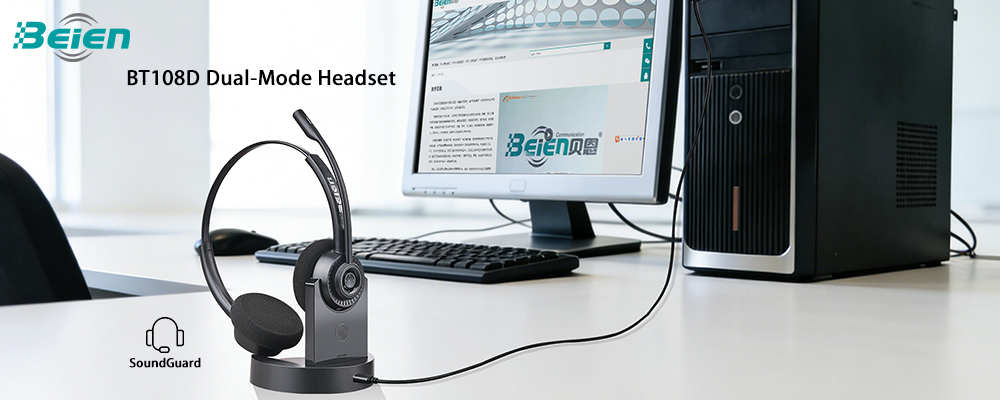
Standard noise cancellation is cheap. A quality usb noise cancelling headset with dual-mic ENC ensures the customer hears you clearly. But an over ear headset noise cancelling equipped with both ENC and SoundGuard ensures the agent stays safe.
Next time you are procuring equipment, look beyond the basic specs. Ask this one question: "Does your headset feature peak limiting above 118dB?"
Don't let your team trade their hearing health for an 8-hour workday.


