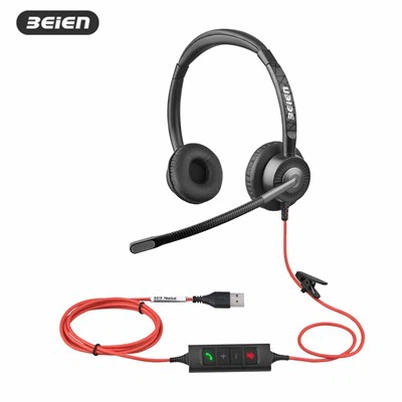
is usb headset better than jack?
Mar 28, 2026
Leave a message
Both USB and 3.5mm headsets have their respective strengths and weaknesses; there is no absolute "better" option, as the choice ultimately depends on your specific usage scenarios and devices.
1. Signal Processing Comparison
- 3.5mm headsets transmit analog signals, relying on the device's internal DAC (Digital-to-Analog Converter) and sound card to handle the decoding process.
- USB headsets transmit digital signals; they feature a built-in DAC chip within the headphones themselves, which is responsible for converting the digital signal into sound.
2. Sound Quality Comparison
- USB headsets can be equipped with a dedicated DAC, thereby bypassing potential issues regarding the poor quality of sound cards built into phones or computers. If the DAC within your USB headsets is of high quality, the sound quality remains assured-even if you are using an older computer. Consequently, the actual audio performance depends entirely on the quality of the chips built into the USB headphones themselves; if the internal chips are of poor quality, the sound quality may actually be inferior to that of a 3.5mm headphone in the same price range.
- In the realms of audiophilia and professional audio, 3.5mm analog headphones remain the mainstream standard. In this context, the headphones are solely responsible for "producing sound," while the DAC and amplification functions are handled by separate, dedicated devices. Users can independently upgrade their DACs and headphone amplifiers to achieve superior sound quality-a pursuit with virtually no upper limit.
Noise vs. Clarity--FC22 Headset ENC Noise Cancellation Test
FC22 Headset: Office Headset with Noise Cancelling Mic for Work
3. Compatibility and Convenience
- The 3.5mm plug offers exceptional versatility, being compatible with virtually all devices-including mobile phones, computers, game consoles, and more.
- USB headsets are limited to devices equipped with a USB port; furthermore, certain models may require driver support when used with different operating systems.
4. Extended Functionality
- USB interface provides power, enabling support for additional features such as virtual 7.1 surround sound, RGB lighting, in-line controls, and noise cancellation.
- 3.5mm headsets offer relatively simpler functionality, yet they feature plug-and-play convenience and zero latency.
Keywords: noise cancelling headset with mic, 3.5mm headset with mic, noise cancelling headset for call center, usb computer headset, noise cancelling mic headset