

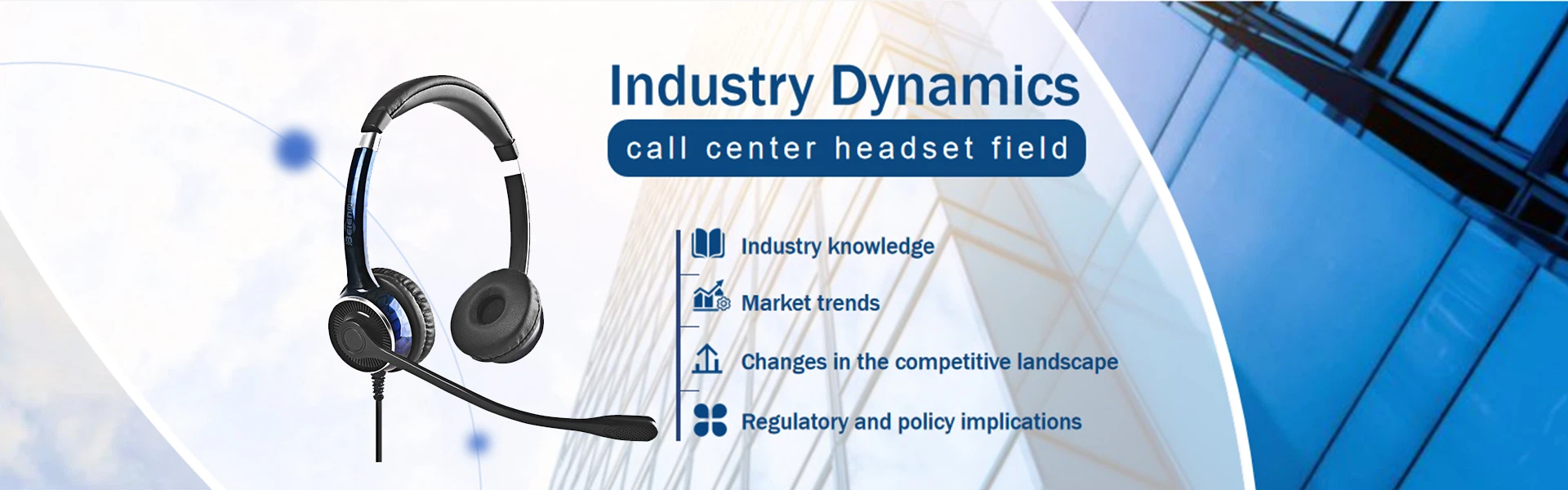
What's the difference between a call center headset and regular headphones?
Leave a message
How many call center headsets are procured annually? Just how large is this market, really?
According to statistics from the market research firm QYResearch, global sales revenue for call center headsets reached $1.546 billion (approximately 11.1 billion RMB) in 2024. This figure is projected to grow to $2.18 billion by 2031, representing a Compound Annual Growth Rate (CAGR) of 5.1%. If we expand the scope to the broader category of "Office + Call Center" headsets, the global market size reached $6.72 billion in 2024. It is expected to grow by nearly $2.7 billion by 2029, boasting a CAGR of 13.8%-a growth rate that highlights a clear trend: professional-grade headsets are becoming standard equipment for an increasing number of enterprises.
Another statistic offers an even more intuitive perspective: in 2025, global sales volume for commercial headsets is projected to reach approximately 98 million units, with an average unit price of around $34. Every year, nearly 100 million headsets flow into the enterprise, call center, and remote work markets.
Now, let's turn to the Chinese market. As of 2024, the number of call center agent seats in China reached 4.4 million-an 8.6% increase year-on-year. In that same year, the market size of China's call center industry reached 55.3 billion RMB (approximately $7.8 billion). As the world's second-largest market, China accounts for roughly 13% of the global market share.
A simple calculation puts this into perspective: with 4.4 million agent seats and assuming an annual replacement rate of 50%, China alone generates a procurement demand for over 2 million headsets each year.
For procurement professionals facing a vast and highly fragmented supply chain, the choices you make directly impact the quality of service delivered by your agents-as well as your own operational management costs.

You sit at your call center workstation, wearing a headset that looks-at a glance-perfectly professional; yet, whenever you're on a call, the person on the other end invariably complains, "It's really noisy on your end." You switch to a different headset, but the problem persists. You might wonder if you aren't speaking loudly enough, or perhaps if the microphone isn't positioned correctly. However, in all likelihood, the issue lies not with you, but with the headset itself-it simply may not be designed for this specific line of work.
There is a counterintuitive reality within this industry: an ordinary headset that performs admirably when listening to music may, when repurposed for a call center environment, deliver call clarity inferior even to that of a basic 80-yuan call center headset. This isn't merely a matter of price, nor is it as simple as the old adage "you get what you pay for." The core of the issue lies in the fact that their physical structures and operational objectives are fundamentally different-right down to their very roots.

One Designed for Listening, One for Speaking
- The design objective of standard headphones is to ensure *you* enjoy a superb listening experience. They aim for powerful bass, crisp treble, and an expansive soundstage. Consumer headphones currently on the market-particularly those marketed as "Hi-Fi" or featuring hybrid dynamic-driver and balanced-armature configurations-devote all their energy to optimizing the audio experience on *your* end. But what about the microphone? Typically, it is nothing more than a sesame-seed-sized pinhole located on the in-line remote; its primary function is simply to enable you to make sound, while its fidelity and noise-cancellation capabilities are largely left to chance.
- The design objective of a call center headset, conversely, is to ensure the *other party* hears you clearly. The core function of a call center lies in the exchange of information between two parties, and efficiency in this process directly determines your FCR (First Call Resolution) rate. Consequently, the microphone in a call center headset is treated-in terms of both structural and circuit design-as a distinct, high-priority module. Engineers invest significant effort into optimizing the microphone's directionality, frequency response, and noise-cancellation algorithms to ensure that your voice is transmitted cleanly and consistently to the customer's ears.
- According to 2025 data from industry organizations, the global number of active call center agents has exceeded 15.3 million, collectively handling over 300 million customer calls daily. If every single call required a repetition of "Could you say that again?" due to poor audio clarity, the cumulative waste in time, human resources, and customer experience costs would be astronomical. This is precisely the core reason why audio clarity typically carries a weighting of 25% to 30%-or even higher-in the evaluation process for purchasing call center headsets.

The Divergence of Two Core Technologies
- Noise-cancellation technologies currently available on the market fall primarily into two distinct categories with entirely different applications-a distinction that should never be confused. ANC (Active Noise Cancellation), a standard feature in consumer-grade headphones, operates at the *listening* end; it isolates ambient noise and optimizes the personal listening experience, making it ideal for commuting and entertainment-its sole purpose is to ensure a quiet environment for the wearer. Conversely, ENC (Environmental Noise Cancellation)-a standard feature in professional communication headsets-operates at the *microphone* end; utilizing a dual-microphone array and sophisticated algorithms, it filters out extraneous sounds such as keyboard typing, background chatter, and wind noise from devices, thereby ensuring the pure transmission of the human voice so that the *other party* can hear clearly.
- Precisely because their objectives differ, these two technologies do not exist in a hierarchical relationship where one is inherently "more advanced" than the other. If you are listening to music on the subway, ANC is an absolute necessity. However, in a call center environment, ANC is not only useless but can actually pose safety risks-due to the strong physical pressure of over-ear cups and excessive sound isolation, agents might fail to hear urgent alerts from their colleagues-making ENC the true core value proposition.
Bluetooth vs. Wired: A Comparison of Pros and Cons in Call Center Environments
- Many managers mistakenly assume that wireless headsets represent the inevitable industry trend-that Bluetooth technology will eventually supplant wired connections. However, the widespread adoption of consumer-grade wireless devices does not translate effectively to the specialized communication demands of a call center; latency remains a critical, fundamental flaw. Bluetooth headsets typically exhibit a latency of 160–270ms-with mainstream models averaging 200–220ms-whereas wired headsets boast a mere 5–10ms delay, offering near real-time transmission. In high-frequency customer service interactions, even a millisecond-level audio delay can disrupt the natural rhythm of conversation, leading to increased agent fatigue over time and a higher likelihood of communication errors.
- The primary advantage of Bluetooth lies in its flexibility and freedom of movement, making it ideal for scenarios involving mobility, training sessions, or temporary workspaces. Conversely, wired headsets-distinguished by their low latency, stable connectivity, absence of static, and uninterrupted connections-remain the preferred choice and an essential requirement for most enterprises. Even as the number of remote agents continues to rise year after year, the majority of work-from-home personnel still prioritize wired communication headsets to ensure optimal call quality.

The Seriously Underrated Parameter
- When selecting a headset for call center use, many people focus solely on the 20–20,000 Hz full-frequency response range. While this specification may appear impressive on paper, it holds limited practical significance for actual voice communication.
- Professional call center headsets (featuring Wideband Audio / HD Voice) adhere to a standard frequency response range of 50 Hz–7 kHz (or 100 Hz–6.8 kHz, representing an optimized engineering range). In contrast to traditional narrowband telephony (300–3,400 Hz), this wider range allows for the faithful reproduction of vocal timbre and articulation nuances. It ensures that numbers, technical jargon, and consonant sounds are articulated with greater clarity, thereby reducing the need for repeated inquiries. Furthermore, it renders voices sounding natural and smooth, while minimizing the distortion and artifacts often associated with telephone audio compression-effectively reducing auditory fatigue for agents engaged in prolonged conversations. Compatible with IP phones, cloud-based call centers, and conferencing software, these headsets are the standard-issue equipment for professional telecommunications environments.
Regarding the microphone, a unidirectional design is the preferred choice; it focuses on capturing the speaker's voice directly while attenuating background noise sources such as rustling papers, accidental bumps, and ambient chatter.
Impedance is another critical parameter that is all too easily overlooked.
Standard consumer headphones typically feature an impedance of 16–32 Ω, making them suitable primarily for mobile phones and recreational computer use. Professional call center headsets, however, offer impedance options of 32 Ω or 150 Ω, allowing for precise electrical matching with specialized equipment such as desktop computers, laptops, USB audio adapters, IP phones, desk phones, and PBX systems.
Connecting low-impedance headphones to professional telecommunications equipment can easily result in volume spikes, audible background hiss (electrical noise), and audio distortion. Conversely, ensuring proper impedance matching guarantees crystal-clear, interference-free communication and long-term operational stability-making it a crucial, albeit often invisible, factor in successful enterprise telecommunications deployments.
Introduction to Beien: The Direct Manufacturer of Call Center Headsets

Three Practical Tips for Cutting Through the Fog of Technical Specifications
- First, do not rely solely on spec sheets. Many brands use eye-catching noise-cancellation figures in their promotional materials to attract buyers; instead, you should request that suppliers provide a noise-cancellation frequency response curve. The wider the frequency range covered by the curve (e.g., from 100 Hz to 1500 Hz), the more ideal the actual noise-cancellation experience will be. Products that claim 40dB+ of noise cancellation based on just one or two "peak data points" are highly likely to be "laboratory-specific" anomalies; in the core speech frequency range (relevant to human voices), their actual effectiveness may be only around 25dB, significantly compromising their practical utility.
- Second, use recordings to evaluate performance. Do not rely solely on product descriptions; ask suppliers to send a sample audio or video recording captured in a real-world setting. Play this recording to simulate a genuine call center environment-complete with keyboard typing, air conditioning fan noise, and the chatter of neighboring agents-and listen/watch for just 20 seconds to make a judgment: if you can clearly distinguish every spoken sentence without the audio sounding thin or hollow due to excessive noise cancellation, the product can generally be deemed satisfactory.
- Third, time is the greatest hidden cost. A low-quality headset costing 50 yuan may appear to offer excellent value for money, but it actually conceals significant hidden costs: it requires replacement every six months; furthermore, when you factor in customer complaints caused by poor call quality, the auditory fatigue and psychological stress experienced by agents during prolonged use, and the maintenance time invested by management, its Total Cost of Ownership (TCO) may far exceed that of a high-quality 150-yuan headset. You may have encountered this calculation in industry reports, but in the context of actual daily office operations, it is often easily overlooked.
Regarding the distinction between professional call center headsets and standard consumer headphones, industry professionals have often raised the question: Can a pair of multi-functional, dual-channel consumer headphones-even if equipped with a boom microphone-effectively serve as a substitute for a dedicated call center headset? While technically feasible, this approach presents numerous drawbacks in practice: the operational logic is complex (requiring frequent mode switching); battery life is entirely dependent on the host device's power supply; and the core noise-cancellation technology is optimized for *listening* rather than *speaking*-rendering it incapable of perfectly meeting the core requirements of a call center environment: "crystal-clear voice transmission" and "seamless, convenient operation."
Industry insiders also frequently express concern regarding "tensile strength" and "cable longevity." The cables on professional call center headsets undergo rigorous bending tests involving tens of thousands of cycles, whereas standard consumer-grade headphones are designed merely to meet the criteria for light, everyday use. An unwritten rule prevails within the industry: repair tickets citing "cable breakage" account for a significantly higher proportion of issues than those involving damaged driver units. This clearly demonstrates that in high-frequency, high-intensity call center environments, the physical durability of the cabling is far more critical than one might initially assume.
Therefore, when procuring headsets for your team of call center agents, consider setting aside flashy brand gimmicks and inflated budgets to first clarify your fundamental requirements. What your agents truly need is a professional office tool-one that ensures customers can hear them clearly, remains comfortable during extended wear, and possesses the rugged durability to withstand constant, heavy usage-rather than a consumer audio gadget designed primarily for entertainment purposes. This fundamental insight is far more valuable than any numerical specification listed on a product's technical data sheet.
Keywords: noise cancelling call center headset, contact center headsets, headset for office telephone, wired headset over ear, professional headset


